NEWS
12/17/2025
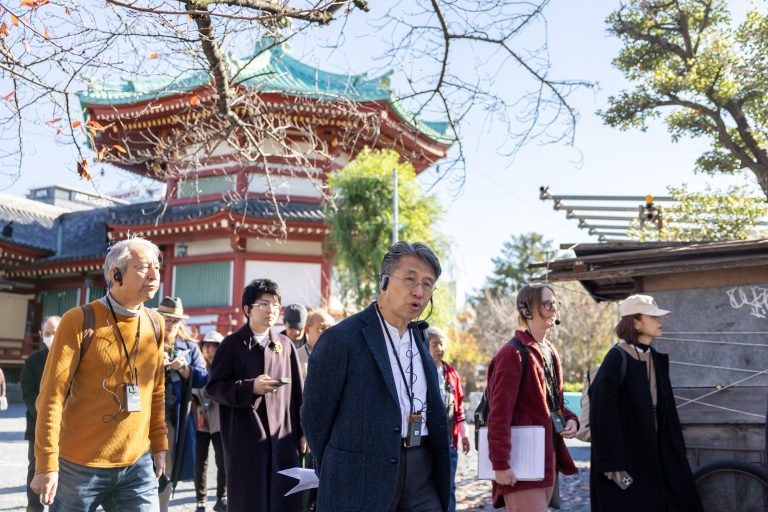
Sanpo University: Special Field Lecture (Ueno–Hongo–Myogadani Route), Friday, November 28, 2025
Lecturer (center): Shunya Yoshimi (President, Sanpo University; Professor, Faculty of Tourism and Community Development, Kokugakuin University)
Photo: Akiko Sugiyama (Yukai)
The project “Sanpo University”, presented as part of Tokyo Biennale 2025, explored the question “What is walking?” from multiple perspectives through a series of lectures and fieldwork programs.
By walking through Tokyo and visiting its streets, alleys, topography, architecture, and waterfronts, the project sought to academically examine walking as an everyday practice. Tracing layers of time and memory that overlap from the past to the present, it aimed to read walking as a means of engaging with the city. The project was led by sociologist Shunya Yoshimi as President and architectural historian Hidenobu Jinnai as Vice President, and included walking tours as well as a lecture series with invited guests.
The project originated in a series of fieldwork-based tours held in autumn 2024 as part of the Tokyo Biennale 2025 Pre-Action, preceding the official opening of the biennale. Yoshimi led a special walking fieldwork in the Ueno–Yanaka area, while Jinnai conducted a similar walk in the Nihonbashi area, both inviting participants to experience walking as a form of critical inquiry.
In early 2025, building on these activities, the first special lecture of Sanpo University was held. Alongside Yoshimi and Jinnai, Kazuko Koike, Creative Director and Co-Representative of the Tokyo Biennale Citizens’ Committee—who had also led a walking tour in the Ueno–Okachimachi area during the Pre-Action—joined the session as a speaker. The lecture was moderated by Susumu Namikawa and Min Nishihara, curatorial members of the Tokyo Biennale 2025, and began by exploring the appeal of walking and how this everyday act might be connected to various themes, genres, and academic disciplines.
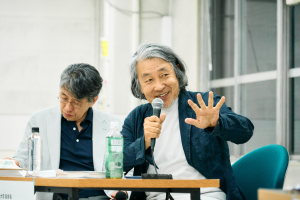
Hidenobu Jinnai (Professor Emeritus, Hosei Uiversity; Director, Chuo City Chuo Historical Museum) Photo: Tsukio Nakanishi
In the following three lectures, we welcomed guests specializing in literature, topography, and geography—Hiromichi Hosoma, Norihisa Minagawa, and Naoki Oshiro—who led us into a deep inquiry into how we see and how we walk the city of Tokyo.
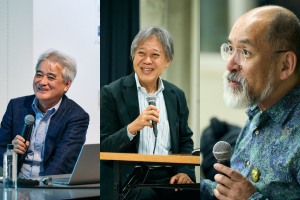
From left: Naoki Oshiro (Professor of Cultural Geography, Meiji University Faculty of Letters), Norihisa Minagawa (President, Tokyo Suribachi Society), Hiromichi Hosoma (Professor, Faculty of Letters, Arts and Sciences, Waseda University) Photo: Tsukio Nakanishi
Their embodied methodologies of urban walking offered significant insights for the artistic expressions of “walking” across this Biennale. We would like to express our sincere gratitude to all our guest speakers.
Continuing from last year’s pre-actions, the field excursions were led by Professors Shunya Yoshimi and Hidenobu Jinnai, who guided participants through tours tracing Tokyo’s layered histories and geographies.
Professor Jinnai’s tour led us from Nihonbashi through Hatchobori, Akashi, and Tsukudajima, where we experienced Edo’s foundational urban culture and the richness—and transformations—of waterfront culture from the modern era to today.
Professor Yoshimi’s tour began in Ueno and traversed the University of Tokyo area, Kasuga, Koishikawa, Kohinata, and Sekiguchi—crossing numerous ridgelines and valleys.
It was a physically demanding route, almost like a triathlon, yet an extraordinary journey that allowed us to feel the dynamism of Tokyo’s undulating terrain through our own bodies.
With this, all programs for this year have been successfully completed.
We extend our deepest appreciation to Dean Shunya Yoshimi and Vice Dean Hidenobu Jinnai, who throughout the year offered inspiring perspectives on the city of Tokyo and continually illuminated its inherent魅力 and its hopeful visions for the future.
We are equally grateful to all participants who joined our lectures and fieldwork sessions, walking through Tokyo from their own perspectives and enriching “Sampo University” with their curiosity, discoveries, and shared learning.
Walking is a quiet act of resistance to the linear, goal-oriented time—marked by the desire for “faster / higher / stronger”—that modern capitalism has imposed upon us.
To step into a narrow side street, to turn, meander, pause, observe, climb, descend, stumble, and discover—is to read the city anew through its layered traces of history, and to sense the signs that point toward the future.
Creation emerges from the very process of walking.
This is why art itself is a form of walking
By refusing the shortest distance to an answer and instead choosing to wander off the main path, we open ourselves to discoveries and acts of creation that lead us into the future.
Such wandering—such generative detours—is both the essence of art and the essence of walking.
We would like to express our sincere gratitude to everyone who participated, to all the professors who generously supported the program, and to all those who helped make this initiative possible.
Through the convergence of each person’s steps and perspectives, “Sanpo University” became a truly rich and meaningful place of learning.
We look forward to meeting you again—somewhere, on another walk.
Tokyo Biennale 2025
“Sanpo University” Program Team


 TOP
TOP