Sukima Project / Nihonbashi-Muromachi, Honcho
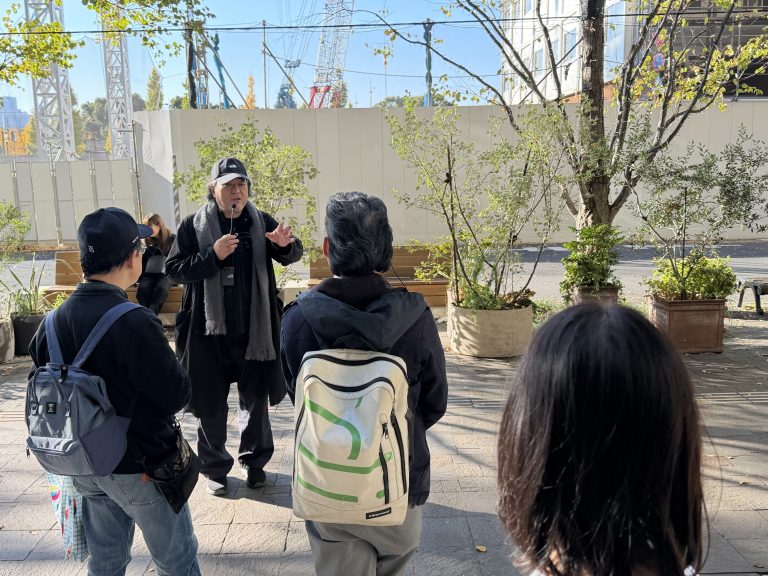
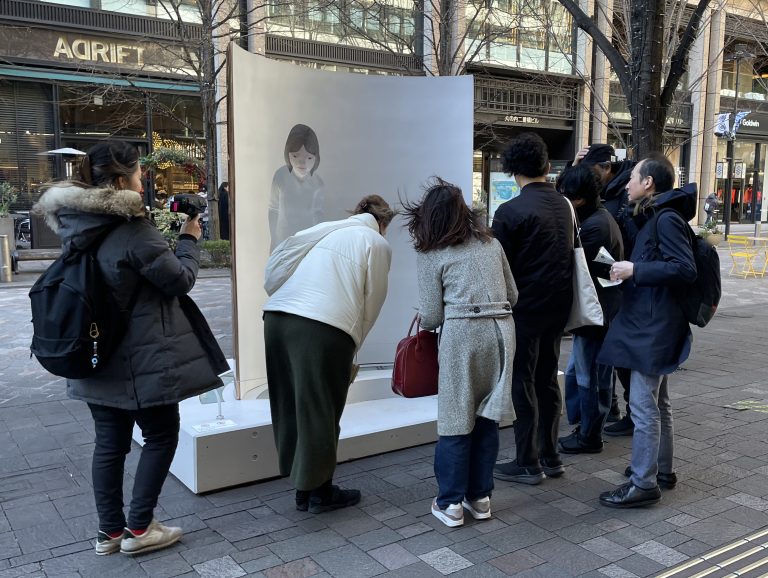
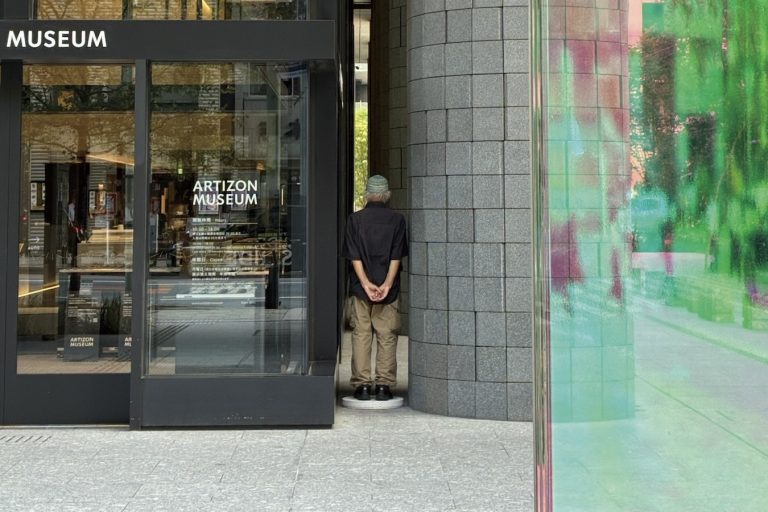
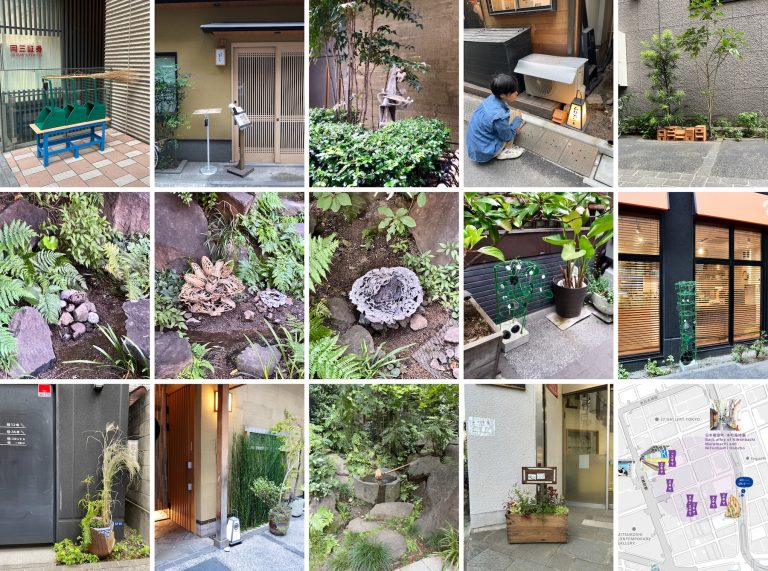
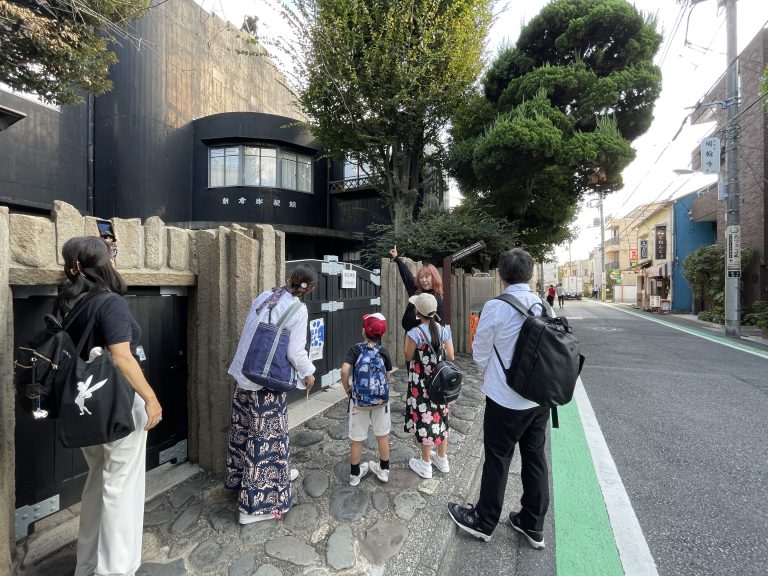
This project is an attempt to grasp the structure of the city from the perspective of its physical and conceptual “gaps,” and to utilize these small spaces between buildings as places for presenting artworks or as artworks themselves. This is a legendary project that Masato Nakamura, along with his artist initiative commandN, carried out in 1999. For the biennale, sculptures by artists that mimic potted plants will seemingly thread these gaps of back alleys together to enrich the city’s marginal spaces.
Sponsor: Mitsui Fudosan Co., Ltd.
Artists and Works
Sumiko Iwaoka, Gar(e)den
* This work is exhibited near the entrance of the Etoile Kaito Living Building.
Click here for the audio guide
In my daily life, I find beauty in the posters, lettering, and traces of street art on signboards, and in the way they gradually fade over time. These surfaces bear the marks of human actions and sometimes possess a charm that evokes art history. Their colors can resemble abstract paintings, and the layered acts of pasting, painting, peeling, and erasing recall the technique of décollage—unconsciously creating a single image. While some may see this as mere “dirt,” if such signboards were displayed in a museum, people might observe them with care and even find beauty in them.
For this project, I place planters in the city with real flowers, accompanied by signboards whose worn surfaces are meticulously recreated in paint. Through this, I aim to express traces of action and unconscious layering using the medium of paint. I hope this small intervention, blending into the urban environment, will bring passersby a quiet sense of unease and a moment of discovery.
Junya Kataoka+Rie Iwatake, A Back Alley That Breathes
Click here for the audio guide
The potted plants sway, thin wires resonate. Their vibrating outlines trace the unseen shape of the wind, announcing the city’s breath.
Yoshiaki Kuribara, I saw a KAWAUSO♡
Click here for the audio guide
Once, the Japanese river otter (Nihon Kawauso) lived along the waterways of Japan, beloved by people, but it has since disappeared. Believed to be extinct, it now survives only in our memories, as a species lost from this world.
This work embodies the idea of an “unexpected encounter” — imagining what it would be like if, in the very heart of the city at Nihonbashi-Muromachi, near the Nihonbashi River, an otter were to suddenly appear from between the plantings. Through ceramic sculpture, the work seeks to summon the presence of nature hidden within the city, aiming for an imagined encounter with a life that has vanished.
When one unexpectedly meets the gaze of this small being, the everyday scenery of the city becomes imbued with stories that stretch from the present, back through Edo, and further into the past. I hope it offers an opportunity to reflect on our future, living together with nature.
6lines studio + Yoshiharu Tsukamoto, Ie haniwa of Nihonbashi
Click here for the audio guide
Urban development has resulted in transparent skyscrapers. Standing in the alleys within the town blocks, this place is relatively low and dark, and the area of Nihonbashi seems as if it has sunk to the depths of the earth. Nihonbashi has flourished as a hub of people and goods, which has continued to develop during the Meiji era.
However, experiencing the destruction around the last war, its historical appearance has changed significantly. Every place has its own path to where it is today, and it is impossible to describe its current state without that path. It is no longer possible to see the streetscape that was once called “the best in Japan,” but we can still find many gaps there created by the Edo land division existing even today, as it survives beyond human time. We are recalling the past by creating ceramic pieces in the shape of the buildings that once made up Nihonbashi and arranging them in various gaps in the town.
Koko Terauchi, The “What if” Stone
Click here for the audio guide
We casually place shiny small stone objects in the corners of parks and alleys, beside flowerpots, and in small stone hangouts. They look like “just stones,” but they have a shape and texture that is somehow intriguing, drawing in the viewer’s gaze to make them suddenly think, “Could it be…?”
“This could be a fossil of the eye of a Triceratops.”
This is the kind of artwork that gives room for imagination, reminding us of our childhood fantasies and idle conversations.
Shoko Toda, Bounce back, eyes and buds
Click here for the audio guide
“Tokyo, Nihonbashi, the bread shop on Garigari Mountain, and Tsuneko-san climbing the stairs, ko-cho, ko-cho” (from a Japanese nursery rhyme).
The hands and arms have become the streetscape of Nihonbashi. Between the fingers are alleys. In the small alleys, potted plants grow together like downy hair. Upon closer inspection, eyes are emerging. Like pores glowing with moisture, they seem to gaze intently at us. To help nurture the downy hair, let us erect supports and cover them with netting. By cherishing the sprouts, we can see far into the distance. What can be seen from there? Where does this staircase of arms lead?
Milk Souko The Coconuts, Manyo Grass in Wild Ascent
From left: Manyo Grass in Wild Ascent, The Untamed Fields: Plantation I (Countless grasses surge forth; the fields bow to none); Manyo Grass in Wild Ascent, Beyond the Walled Bounds: Plantation II
(Countless grasses surge forth; breaking free from the walled colony)
Click here for the audio guide
This work seeks to transpose the very existence of an alley into the form of a small potted plant.
It gathers the miscellaneous forms and layered histories that linger in the backstreets of downtown and reassembles them within a single pot, revealing a cross-section of the city that resists any unifying frame.
The pot interweaves restoration techniques such as kintsugi (gold joinery), kasugai-tsugi (staple joinery), and yobitsugi (patch joinery), suturing together fragments of ceramic, concrete, stone, plastic, and more. This mingling of materials and methods places fragments from different cultures and eras side by side, and moreover captures aspects of the city that slip through hegemonically prescribed orders of vision—moments found in the rhythms, modulations, and subtle fluctuations of cobblestones and louvers; the shadows beneath overpasses; or the drip edges that frame buildings.
The mixed planting brings together ornamental imports, native species, their hybrids, and even plants commonly called weeds.
In the midst of competition, they display brief moments of coexistence, embodying the untamed wildness of a living back alley—remaining resistant to domestication.
Osamu Mori, Power chord – Praying hands
Click here for the audio guide
In the stalactites formed over vast spans of time through gravity and other forces, I recognized the shape of prayer.
The gesture of bringing the hands together in prayer appears across many religions. I recall, as a child, often gathering “energy” in my palms, imagining I might release a Kamehameha or Hadouken.
Like this stone, if given enough time, I feel that intentions too can take form.
In a temizu-bachi—stone water basins found in the city, whose shape evokes rocks hollowed by the force of water—I will install a work carved from stalactites that themselves were formed over long years by water’s steady hand.



 TOP
TOP